HANDOFF
Now open for early access

Shared Context
Across Humans & Agents

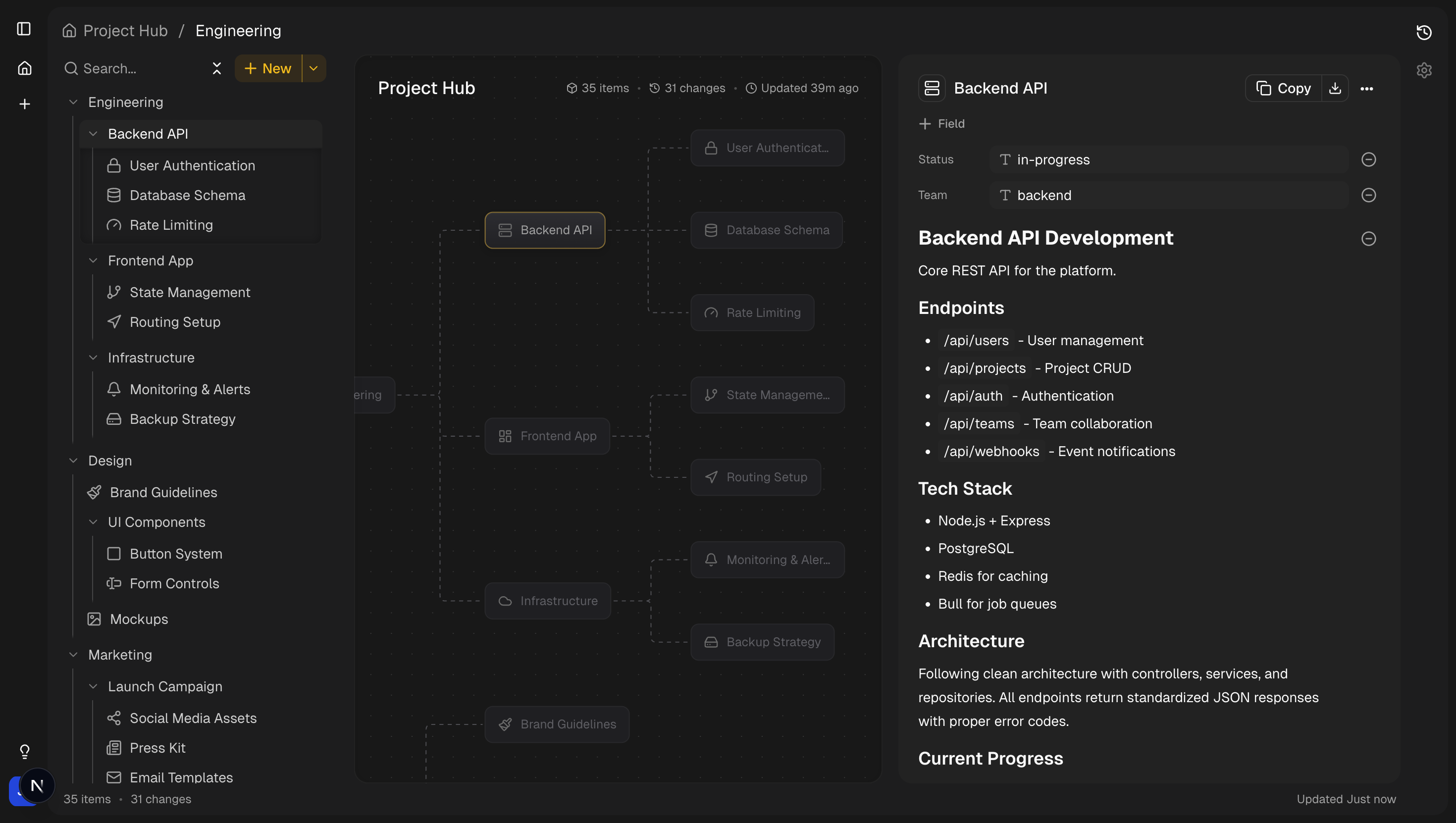
Track what your team and agents know. Handoff is a real-time temporal knowledge graph that syncs with your tools. Always current. Built for human-agent collaboration.
Read our manifesto →
Without Handoff

Context scattered everywhere.

Nothing connected. Every session starts from scratch.

  • Re-explaining project context every session
  • Copy-pasting between tools and chats
  • Agent memory locked in opaque black boxes
  • No visibility into what AI actually knows
The Solution

Durable Context.
Shared Understanding.

No more stale context. Handoff keeps your knowledge current and delivers exactly what each person and agent needs.

Capture
Organize
Track
Share
The Handoff Difference

Purpose-Built for AI and Humans

Most tools give you docs or basic memory. Handoff gives you structured, connected context with full history and a human-first interface.

Temporal Context

Every change tracked with revert capabilities and audit trails. Never lose context.

Bring-Your-Own-Agent

Built on MCP. Works with any MCP-compatible client.

Agent Presence Engine

Real-time sync keeps teams and agents on the same page, instantly.

Edge-Native Infrastructure

Built for global consistency and low-latency access worldwide.

Coming Soon

Public Workspaces

Publish workspaces as MCP servers other agents can query.

Coming Soon

Integration Components

Auto-populate your graph from Gmail, Slack, GitHub, and more. Context that stays fresh.

Workflows

Context that works the way you do

Solo or team. One agent or many. Handoff adapts to your setup.

Solo Builders

Your second brain, agent-ready

Keep task lists, code patterns, and project context in one place. Access it from Cursor, Claude, or any MCP client. No more re-explaining your codebase every session.

Teams

Shared context, always current

Decision logs, project state, onboarding docs. Everyone and every agent works from the same source of truth. Changes sync in real-time.

How Handoff Compares

Not another docs tool. Not another AI memory layer. A new category built for human-agent collaboration.

FeatureHandoffNotion/ObsidianMem. SystemsRAG Pipelines
Real-time multiplayer
Agent-native (MCP)
Inspectable context
Temporal context
Native graph relations
Human-first UI

Simple Pricing

Start for free, scale as you grow. Questions? Contact us

Free

$0

For individuals and hobbyists.

  • 3 workspaces
  • 25 items per workspace
  • MCP server access
  • Export context packs
Sign up free
Most Popular

Plus

$29/month

For serious builders.

  • Everything in Free
  • 3 team members
  • 10 workspaces
  • 500 items per workspace
  • Early access to new features
  • Priority support
Start Plus

Pro

$99/month

For growing teams and agencies.

  • Everything in Plus
  • 6 team members
  • 100 workspaces
  • 1,000 items per workspace
  • SLA support (24hr response)
  • Dedicated support channel
Start Pro

Enterprise

Let's talk

For teams with compliance needs.

  • Unlimited usage
  • Unlimited members
  • Dedicated support & SLAs
  • SSO/SAML
  • Data isolation
  • Onboarding & training
Contact sales

Frequently Asked Questions

Everything you need to know before getting started.

Notion and Obsidian are great for human-written docs, but they weren't built for AI. Handoff is agent-first: real-time MCP integration, structured context graphs, and version history designed for human-agent collaboration. Your agents can read and write context directly, not just consume static exports.
Most AI memory systems are black boxes. You put information in and hope the right things come out. Handoff gives you full visibility: inspect what's stored, edit what's wrong, share what's valuable. Your context is open and under your control, not locked in proprietary systems.
Agents load a graph overview first: the structure and hierarchy of items without the content embedded in each node. From there, they can drill into specific items as needed. We're actively optimizing this for larger graphs and our MCP tools that are exposed to the agent.
Any agent that supports the Model Context Protocol (MCP). This includes Claude, ChatGPT (via plugins), Cursor, and many others. If your agent speaks MCP, it works with Handoff.
Three ways: (1) Use the copy button in Handoff Studio to grab markdown and paste into any chat. (2) Connect via MCP and let agents query context using tools like items (op="list") and search. (3) Attach a workspace as an MCP resource to inject full context at the start of a conversation.
Handoff uses a flexible, semi-schemaless git-like graph model for temporal context. Items have a core structure (title, hierarchy, timestamps) but can include any custom fields you need. This makes it easy to start capturing context immediately. Typed schemas and validation are on the roadmap for teams that need more relational structure and consistency across their graphs.
Right now, Handoff focuses on structured text and metadata. Support for images, file attachments, and other media types is on the roadmap. We're building the foundation for rich context first, then expanding to handle more content types.
Absolutely. Solo builders use Handoff to keep task lists accessible from any AI tool, store code patterns and anti-patterns agents should follow, track high-level goals across projects, and maintain portable prompts that work in Claude, Cursor, or any MCP client.
Start simple: create a workspace and add items for whatever you're working on. Tasks, decisions, notes, reference material. Don't overthink the structure upfront. As patterns emerge, organize items into hierarchies and add custom fields.
Yes. The free tier includes 3 workspaces with 25 items each, enough to explore Handoff and see if it fits your workflow. Upgrade when you need more capacity or team features.
Yes. All traffic uses TLS encryption (HTTPS/WSS). Data is stored in Planetscale (PostgreSQL) and Cloudflare R2, both encrypted at rest. We never sell your data or use your workspace content to train our own models. You can export your data anytime.
Full self-hosting isn't available today. If you have strict data residency or compliance requirements, contact us. We're open to exploring options.